Scientists everywhere were wrong about there not being a relationship between the Russian Chebarkul meteorite and asteroid 2012 DA 14. Organizations everywhere, like NASA, prematurely reported for everyone what and how to believe, as from the expertise of authority, going against true science by saying it was a cosmic coincidence. It was not a coincidence, as we said last week in our story Russian Meteorite and Asteroid 2012 DA14 Likely A Related Incident that asteroids will produce associated magnetized fragments that can be deflected by magnetic fields in space.
 |
| An Apollo asteroid came very near asteroid 2012 DA14 a few days before the Russian Chebarkul meteorite impacted. There are about 80 million Apollo asteroids. Most asteroids have smaller associated magnetized fragments that can suddenly change trajectories if a massive body disrupts the magnetic fields |





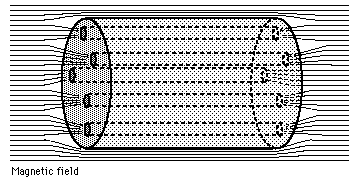
NASA has explained that CME and coronal ejections are difficult to track for this very reason; they may start out and then alter their trajectory in very significant ways via sudden angle change.
ReplyDeleteMagnetism
Yes that's very true about the sun, and they're worried about the upcoming cycle causing damage satellites and electronics. A Faraday shield can protect your computer from a worldwide CME, but could be expensive. The solar wind too is highly variable throughout the solar system, and is shielded behind earth's magnetosphere,away from the sun, and nearer to the direction the asteroid approached.The Russian fireball orbit was magnetically compressed and came in from the sun in the opposite trajectory.
ReplyDelete